Wednesday, 16 May 2018

NARASIMHA AVATAR


Image result for narasimha avatar

However Prahlad was quite different from his father. Unlike his father Prahlad never hurt another living being. He was a strong devotee of Lord Vishnu and liked praying to the Dark Lord. Prahlad was kind gentle and firm to all people around him. While everyone was scared of Hiranyakasipu, all the people loved Prahlad.
Narasimha is an avatar of the Hindu god Vishnu, one who incarnates in the form of part lion and part man to destroy an evil, end religious persecution and calamity on Earth, thereby restoring Dharma.
Narasimha iconography shows him with a human torso and lower body, with a lion face and claws, typically with a demon Hiranyakashipu in his lap whom he is in the process of killing. The demon is powerful brother of evil Hiranyaksha who had been previously killed by Vishnu, who hated Vishnu for killing his brother. Hiranyakashipu gains special powers by which he could not be killed during the day or night, inside or outside, by god, demon, man or animal.


HIRANYAKASHIPU AND PRAHLAD


Image result for hiranyakashipu
During the Satya Yuga, Sage Kashyap and one of his wife Diti had two sons – Hiranyaksha and Hiranyakasipu. Hiranyaksha troubled the humans and the Devas alike. The humans and the Devas unable to take it any more prayed to Lord Vishnu to protect them. Lord Vishnu being the Preserver incarnated as a Boar to protect the humans and the Devas. This avatar is called as Varaha Avatar.

After the death of Hiranyaksha,Hiranyakasipu furious with the humans and the Devas, lead his army of asuras to attack them. However the Devas fought Hiranyakasipu and his men. Hiranyakasipu came to know that every time, Lord Vishnu helped the Devas to fight him back.

Hiranyakasipu started his meditation and soon forgot all about himself and his kingdom....

Indra looked at the angry sage and realised that he had no choice other than to let Kayadu go. Indra nodded at his men an they vanished from there leaving Kayadu in the middle of the ruined capital.

Sage Narada held up his hands, 'Peace my child...I know you are carrying a child. Such anger is not good either for you or the child...'

Kayadu looked at the sage and again took a deep breath calming herself.

Sage Narada waited until she was calm and spoke again, 'What will you do now? Is there any place you know which is safe for you?'

Kayadu looked around her at all the dead asuras and thought, If I stay hear, Indra may come back...She shuddered slightly, At that time, the sage may not be there to speak for me...In my position, I may not be able to fight Indra...'She thought thinking about the child in her womb...She looked at the sage and bowed her head, 'Great Sage! I have a request for you...' She said looking at Sage Narada.

Narada nodded his head asking her to continue. Kayadu spoke, 'I will look after you as your own daughter...Would you please take me to your hermitage...If...if it is ok with you...' She said feeling slightly desperate...

Narada smiled. This was the reason Narada had come here – to take Kayadu to his home..It had started..

Kayadu accompanied Sage Narada to his home and there Kayadu looked after the Sage well. Sage Narada found Kayadu to be extremely intelligent and with a quick grasp. In the evenings, Sage Narada would relax and tell Kayadu stories of Lord Vishnu....Hearing all this Kayadu developed a profound sense of attachment towards Lord Vishnu.

In her womb, the young unborn baby also heard these stories and also loved Lord Vishnu. The time passed happily there...

Lord Brahma and the other Devas were meanwhile having a very big problem. The air of the heavens were becoming hotter and hotter and the Devas were finding it difficult to breathe. Wondering what had happened, the Devas searched that found that Hiranyakasipu's penance was becoming so powerful that the air of the heavens was burning up. Unable to take it anymore, the Devas ran to Lord Brahma. Lord Brahma agreed to meet Hiranyakasipu and went to earth to meet the Asura.

What he saw there stumped Lord Brahma. Hiranyakasipu was so deep in his prayer that creepers had grown on him...Hiranyakasipu still did not know...

Lord Brahma was touched with the devotion of Hiranyakasipu. He took some water from his Kamandalam and threw it on Hiranyakasipu. Slowly Hiranyakasipu got up from his trance. When the water fell on Hiranyakasipu, he emerged from the creepers new and fresh. He looked at the God of Creation and bowed, 'My Lord!'

Lord Brahma looked at Hiranyakasipu touched, 'Arise son! Your penance is unparalleled! You can have any boon you wish!'

Hiranyakasipu bowed and said, 'My Lord! I wish to be immortal...'

Lord Brahma looked unhappy as he shook his head, 'Son, all who are born have to die. I cannot change the laws of nature. Please ask for something else...'

Hiranyakasipu pouted...All my penances for nothing...Then Hiranyakasipu thought of something, Wait, if I ask for an impossible condition for death probablythen...Hiranyakasipu thought fast and again bowed to Lord Brahma. 'Lord, I wish for a boon...'

Lord Brahma gestured for Hiranyakasipu to continue. Hiranyaksipu spoke in clear tones,

'Lord I wish that I cannot be killed by any man, God or animal or any other creature created by you. Nobody should be able to kill me at day or night, in heavens or in earth, in the day or the night either inside the house or outside the house, or with any weapons...'

When Lord Brahma heard this he stayed still for some time. He knew that granting this boon was not good considering that Hiranyakasipu had shown utter contempt for all other lives. But he also knew that he had no choice. He had to grant whatever was asked of him. Hiranyaksipu's penance had been very powerful.

 Armed with the boon, Hiranyakasipu attacked Indra. Indra had no chance. The Devas were driven out of Devaloka.Hiranyakasipu became the ruler of the Heavens.

Hiranyakasipu found Kayadu and brought back his wife home.

Despite Kayadu asking Hiranyakasipu to change his ways, he continued to torment the humans and the Devas alike, but no one was able to raise a voice against him.

It was at this time that Kayadu gave birth to a fine young baby boy – he was named Prahlad.

As Prahlad was growing up, Hiranyakasipu became more and more powerful and he started committing more and more atrocities.

PRAHLAD BEGINS TO LOVE VISHNU

Image result for prahlad and vishnu

At the school, the Guru taught Prahlad about how Hiranyakasipu was the Lord of the three worlds and how he was to be worshipped...However Prahlad was distracted when he heard this. He shook his head, 'No sir! This is not right! Lord Vishnu is the Lord of the three worlds. The whole universe exists because of him...'

The guru became furious and afraid at the same time. Furious that Prahlad was defying him openly in the class for all the students to hear and afraid that if Prahlad repeated this to his father, Hiranyakasipu may become furious with him.

'Who..who taught you that?' He asked Prahlad furiously.

'It is the truth which can be found anywhere, if you know where to look...' Prahlad said looking straight at his teacher.

The guru dragged Prahlad back to his father's palace. He went to Hiranyakasipu, 'Sir! I have tried everything...The boy keeps on repeating what he said. He would not tell me from where he learnt this...'

Hiranyakasipu got more and more furious as he heard this. Anger blinded him. This is no son of mine...If these are the things he is teaching, he does not have any right to live...HIranyakasipu called his men, 'Guards! Take this boy and kill him with your swords.'

The guard looked anxiously at Hiranyakasipu wondering whether he had indeed ordered for killing the prince.

Hiranyakasipu angrily looked at his men and yelled, 'NOW!'

The men fell over backwards and pulled Prahlad with them. They took out their swords. The first guard struck Prahlad and watched surprised as the blade fell from the hilt...Prahlad looked unharmed and without fear. All the guard together struck Prahlad only to find their blades breaking off even before it struck Prahlad.

Bewildered they turned to Hiranyakasipu. Enraged Hiranyakasipu then ordered Prahlad to be bitten by poisonous snakes. However the bites of the snake did not affect Prahlad at all.

Prahlad then sat under a tree deep in meditation to the Dark Lord. Furious Hiranyakasipu turned on mad elephants at Prahlad to trample him. Hiranyakasipu was stunned when he saw the mad elephants sitting peacefully before Prahlad looking at him.

HOLIKA DAHAN


Image result for holikaHiranyakasipu called his sister Holika. 'Sister Holika! I need your help!'

Holika bowed to Hiranyakasipu, 'Speak my Lord!'

Hiranyakasipu said harshly, 'You have received a boon from the Lord that fire cannot harm you! I want you to use that boon now.'

Holika frowned looking at Hiranyakasipu for explanations. 'My son Prahlad!' Hiranyakasipu spat out, 'He..defies me openly...I don't want to see his face again...I want to kill him..He is no son of mine...I want you to take Prahlad in your lap and hold him tight, so that when I set both of you on fire, he would....'Hiranyakasipu said venomously.

Holika held her hands, 'I understand my Lord!'

Without question Holika picked up the meditating Prahlad and put him on her lap. After she had sat down, Hiranyakasipu set fire to them..That will be the end of him...


However Hiranyakasipu had not calculated the power of devotion. Prahlad gave no sign of even knowing what was going on around him. However Holika, the one who was immune from fire started burning. The fire of her sins burnt her...When the fire finally burnt out, Prahlad was sitting in the middle of a charred place not a hair out of place, whereas Holika was nowhere to be seen...


WHERE IS VISHNU?

Now Hiranyakasipu felt afraid. He went to Prahlad and pulled the boy up. The boy woke up as if from a trance, looking around him. Hiranyakasipu shook him, 'YOU SAY YOUR VISHNU IS EVERY WHERE?' He yelled, 'Where is your Vishnu now? Is he here, behind this tree, Is he here in this setting son, Is he inside my palace? IS HE IN THIS PILLAR?' Hiranyakasipu yelled loudly.

Prahald looked at his father straight in the eye, 'Yes father! Lord Vishnu is everywhere...'

Enraged Hiranyakasipu kicked the pillar and said angrily, 'THEN WHERE IS HE?'


Image result for narasimha
Hiranyakasipu stopped stunned as he saw the pillar shatter and from the pillar emerged a ferocious...What is that? It has the face of a lion and the body of the man...Hiranyakasipu hastily stepped back, looking at the half man-half lion. He shook his head unable to believe himself, when the half-man half-lion bellowed loudly, 'I am Narasimha, the avatar of Narayana, and I have come here to kill you...' Narasimha advanced with glowing eyes. Before Hiranyakasipu could escape, Narasimha caught him with his clawed fingers, in a vice like grip.


Hiranyakasipu struggled against grip, but it was of no use. Narasimha took Hiranyakasipu and dragged him to the threshold of the door [neither inside nor outside the house] and placed him on his lap [neither sky nor the earth] and there killed Hiranyakasipu with his claws [without weapons], at twilight [neither day nor night].

After killing Hiranyakasipu, Narasimha let out a loud roar and sat on Hiranyakasipu's throne.

All the Asuras had escaped from there seeing the ferocious beast. Even the Devas were afraid to go near Narasimha. However unafraid, Prahlad went forward. There was nothing but love in his eyes. 'My Lord! You have come to protect me...I knew you would come...'


Image result for narasimha and prahlad
Looking at the face of Prahlad, Narasimha smiled, 'Yes son! For you I have come!...' Prahlad looked at his father's body and looked at Narasimha, 'Do not worry son! You do not know his story! He is my doorkeeper Vijaya. He was born here because of a curse. After three more births he will attain his place back in Vaikunta...Do not worry about him...'

Prahlad nodded his head, 'I want nothing more, my Lord!'

Narasimha shook his head, 'No son! You are meant to rule your people. You will come to Vaikunta after you have completed your work on earth as your people's ruler...'

Prahhlad nodded his head once more. Prahlad became the benevolent ruler of the Asuras, who prospered during his reign and gave up there old cruel ways.


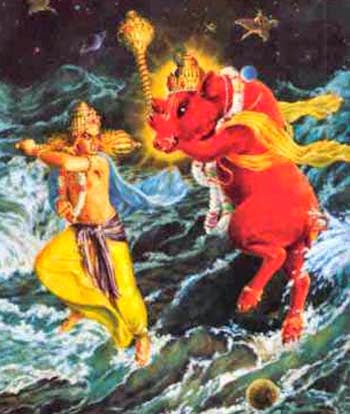


Image result for vishnu symbol

Monday, 26 February 2018

VARAHA AVATAR

Image result for varaha avatar

Varaha is the third Avatar of Lord Vishnu after the Matsya and Kurma Avatars.


In Varaha Lord Vishnu takes the form of a boar to rescue the Goddess Earth. 
In symbolic Hindu mythology, when the demon Hiranyaksha tormented Earth (personified as the Goddess Bhudevi) and its inhabitants, she sank into  the primordial waters. Lord Vishnu,then, took the form of the Varaha, descended into the depths of the ocean to rescue her. He slayed the demon and retrieved the Earth from the ocean, lifting her on his tusks, and restored Bhudevi to her rightful place in the universe.

Varaha has been depicted completely as a boar or in an anthropomorphic form, with a boar's head and human body. The Earth may be depicted as a mass of land balanced on his tusk.

STORY OF VARAHA AVATAR

Image result for varaha avatar and hiranyaksha
One day Lord Vishnu was resting in his palace, when Lord Brahma’s four sons came to meet him. They were stopped at the entrance by his two guards, Jaya and Vijaya. They did not allow them to enter as their master was resting, Brahma’s sons were very angry and cursed Jaya and Vijaya to be born as humans on earth and to leave their godly status.
Jaya and Vijaya were very scared and they rushed to Lord Vishnu and requested him to do something. The Almighty smiled and told them not to worry. They would be born on Earth as Daityas but he will kill them and release them from their curse. But for that they would have to be born three times and killed three times.

So Jaya and Vijaya were born as humans on Earth. They were named Hiranya­kashyap and Hiranyaksh
Many years went by and Hiranyaksha became a young man. He was a great devotee of Lord Brahma. He gave a lot of time in penance when Lord Brahma appeared and gave him a boon. According to the boon, no God, human, Daitya or Asura would be able to kill him. So Hiranyaksha started displaying his strength as he was assured of his immortality.
Hiranyaksha searched for Lord Vishnu everywhere but could not find him. Then he gathered the whole Earth into a round ball and went underwater to Pataal Lok to search for Lord Vishnu. 
Then Lord Vishnu took the form of  Varaha, a wild boar with two tusks. He went to Pataal Lok and challenged Hiranyaksha so they had a fierce fight. 
And then Vishnu directed his chakra at Hiranyaksha.After defeating Hiranyaksha Lord Vishnu again took the Varaha form. He picked the Goddess Earth who was like a ball, balanced on his two tusks and left Pataal Lok. He placed Earth at her rightful position in the universe and again appeared in his true form.
Thus, this marks the end of the third Avatar of Lord Vishnu.
Image result for vishnu symbol

Saturday, 17 February 2018

KURMA AVATAR


 The Kurma Avatar

Continuing with the saga of the avatars of Lord Vishnu,of the Hindu Trinity assigned the Preserver of the Universe manifests himself in different incarnations or avatars to restore righteousness when to restore the equilibrium between good and evil.

Kurma,the second Avatar of Vishnu like the other avatars appeared at the time of crisis to restore the cosmic equilibrium. His iconography is either a tortoise, or more commonly as half man-half tortoise. 

The earliest account of Kurma is found in the Shatapatha Brahmana (Yajur veda), where he is a form of Prajapati-Brahma (the creator of the universe) and helped with the kshirsagara manthan (churning of the Ocean Of Milk.He appears in the form of a tortoise or turtle to support the foundation for the cosmic churning stick (Mount Mandara).


KSHIRSAGARA MANTHAN


 The legend of Kshirsagara Manthan goes as follows

Indra, the King of Heaven and the Gods, while riding on the elephant Airavata, came across Rishi Durvasa who offered him a special garland given to him by Lord Shiva. Indra accepted the garland and placed it on the trunk of the elephant as a test to prove that he was not an egoistic god. The elephant, knowing that Indra had no control over his own ego, threw the garland to the ground. This enraged him as the garland was a dwelling of Sri (fortune) and was to be treated as a prasada or religious offering. Durvasa cursed Indra and all devas to be bereft of all strength, energy, and fortune.

In battles following the incident, the Devas were defeated and Asuras (demons) led by Bali the King of Asuras gained control of the universe. Devas sought help from the Supreme God Vishnu who advised them to treat asuras in a diplomatic manner. Devas formed an alliance with asuras to jointly churn the ocean for the nectar of immortality and to share it among them. However, Vishnu told the Devas that he would arrange for them alone to obtain the nectar.

The churning of the Ocean of Milk was an elaborate process. Mount Mandara was used as the churning rod, and Vasuki, the king of serpents, who abides on Shiva's neck, became the churning rope. The demons demanded to hold the head of the snake, while the gods, taking advice from Vishnu, agreed to hold its tail. As a result, the demons were poisoned by fumes emitted by Vasuki. Despite this, the gods and demons pulled back and forth on the snake's body alternately, causing the mountain to rotate, which in turn churned the ocean. When the mountain was placed on the ocean, it began to sink. Vishnu, in the form of a turtle Kurma, came to their rescue and supported the mountain on his back.

The Samudra Manthana process released a number of things from the Ocean of Milk. One was the lethal poison known as Halahala, which in some versions of the story, escaped from the mouth of the serpent king as the demons and gods churned. This terrified the gods and demons because the poison was so powerful that it could destroy all of creation. Then the gods approached Shiva for protection. Shiva consumed the poison in an act to protect the universe, and his consort, Parvati, grabbed Shiva's throat in an effort to prevent the most deadly poison from affecting the universes inside Lord Shiva. As a result, Shiva's throat turned blue. For this reason, Lord Shiva is also called Neelakantha.


MOHINI


Mohini is the only female avatar of Vishnu. Mohini is introduced into the Hindu belief system in the narrative of samudra manthan. Here, she appears as a form of Vishnu, acquires the pot of Amrita (an elixir of immortality) from the asuras (demons), and gives it back to the devas (gods). 

The earliest reference to a Mohini-type goddess appears in the Samudra manthan episode of the 5th century BCE Hindu epic Mahabharata. The Amrita, or nectar of immortality, is produced by the churning of the Ocean of Milk. The Devas and the Asuras fight over its possession. The Asuras contrive to keep the Amrita for themselves, angering the Devas. 

Vishnu, wise to their plan, assumes the form of an "enchanting damsel". She uses her charm to trick the Asuras into giving her the Amrita, and then distributes it amongst the Devas. Rahu, an Asura, disguises himself as a god and tries to drink some Amrita himself. Surya (the sun-god) and Chandra (the moon-god) quickly inform Vishnu, and he uses the Sudarshana Chakra (the divine discus) to decapitate Rahu, leaving the head immortal. The decapitated body becomes Ketu. Rahu and Ketu are both regarded as celestial bodies that assume one's destiny. 


So this is how once again Vishnu saved the world and made way for another generation where in crisis he would yet take another avatar and save the people of earth.

Image result for vishnu symbol

Thursday, 28 December 2017

THE MATSYA AVATAR


Matsya ,is the avatar of the Hindu god Vishnu in the form of a fish. Often listed as the first avatar in the lists of the ten primary avatars of Vishnu, Matsya is described to have rescued the first man, Manu, from a great deluge. Matsya is depicted as a giant fish, or anthropomorphically with a human torso connected to the rear half of a fish.

THE GREAT DELUGE


The story of a great Deluge is found in many civilizations across the earth. It is often related to the Genesis narrative of the flood and Noah's Ark. The fish motif reminds readers of the Biblical 'Jonah and the Whale' narrative as well; this fish narrative, as well as the saving of the scriptures from a demon, are specifically Hindu traditions of this style of the flood narrative. Similar flood myths also exist in tales from ancient Sumer and Babylonia, Greece, the Maya of Americas and the Yoruba of Africa.

Matsya temples are relatively rare, but the iconography is found in Hindu temple reliefs. 
Matsya is believed to symbolise the aquatic life as the first beings on earth. Another symbolic interpretation of the Matsya mythology is,  to consider Manu's boat to represent moksha (salvation), which helps one to cross over. The Himalayas are treated as a boundary between the earthly existence and land of salvation beyond. The protection of the fish and its horn represent the sacrifices that help guide Manu to salvation. Treated as a parable, the tale advises a good king should protect the weak from the mighty, reversing the "law of fishes" and uphold dharma, like Manu, defines an ideal king. In the tales where the demon hides the Vedas, dharma is threatened and Vishnu as the divine Saviour, rescues dharma, aided by his earthly counterpart, Manu - the king.

MATSYA PURANA


The Matsya Purana evolves the legend further, by identifying the fish-savior (Matsya) with Vishnu instead of Brahma.The Purana derives its name from Matsya.

The Satya Yuga was about to end and a great flood was to come and destroy all the life on earth to start afresh for the next Yuga. Lord Brahma after a day full of creation, was tired. He wanted to go to sleep and was soon snoring loudly.
While Lord Brahma was sleeping an asura Hayagriva emerged from Brahma’s nose. With Brahma asleep, Hayagriva realized that it was the right time to take in all the knowledge of the Vedas. Hayagriva concentrated and soon absorbed the knowledge in the Vedas. He then hid deep inside the ocean, thinking that nobody would find him there.
Lord Vishnu saw this and was worried. If the Vedas were stolen by the asura, the knowledge of the Vedas could not be passed on to the Next Yuga. As a Preserver, it was his job to make sure the knowledge survived to the next Yuga.

The legend  states that when a little fish appeared to Manu, he recognizes Vishnu Vasudeva in the fish. The fish tells him about the impending fiery end of kalpa accompanied with a deluge. The fish once again has a horn, but Manu does not need to build a boat or ship in this Purana. The gods build it. They build it big enough to carry and save all life forms, and Manu needs to just carry all types of grain seeds to produce food for everyone after the deluge is over. When the great flood begins, Manu ties the Ananta Sesha (cosmic serpent) to the fish's horn. 

One half of the fish’s work completed, the fish went to the other side to complete the other reason for the incarnation. On the other end of the ocean, the fish saw Hayagriva guarding the Vedas. Seeing the huge fish, Hayagriva was terrified. What a huge fish…However no sooner than he had thought this, the fish attacked him. The fish was so huge, that a single push sent the asura reeling. Still dazed Hayagriva tried fighting the fish, but the fish was huge and powerful.
After a brief and futile struggle, the asura was dead. Once the asura was dead, the vedas imbibed by him went back to Lord Brahma, who was still asleep.

Image result for vishnu symbol

VISHNU: THE SAVIOUR


Vishnu is one of the principal deities of Hinduism.He is revered as the Preserver in the Holy Trinity along with Brahma and Shiva.

In Vaishnavism, Vishnu is identical to the formless metaphysical concept called Brahman, the supreme, the Svayam Bhagavan, who takes various avatars or incarnations, as "the preserver, protector" whenever the world is threatened with evil, chaos, and destructive forces. His avatars most notably include Rama in the Ramayana and Krishna in the Mahabharata. He is also known as Narayana, Jagannath, Vasudeva, Vithoba, and Hari

In Hindu iconography, Vishnu is usually depicted as a youth with a dark, or pale blue complexion and having four arms. He holds a padma (lotus flower) in his lower left hand, Kaumodaki gada (mace) in his lower right hand, Panchajanya shankha (conch) in his upper left hand and the Sudarshana Chakra (discus) in his upper right hand.


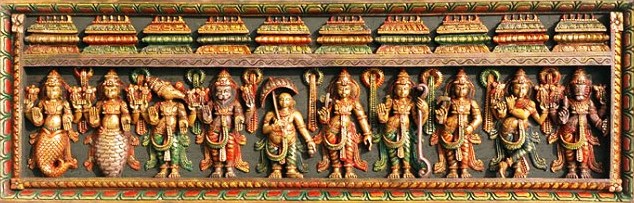
DASHAVATARA


The Vishnu avatars appear in Hindu mythology whenever the cosmos is in crisis, typically because the evil has grown stronger and has thrown the cosmos out of its balance.The avatar then appears in a material form, to destroy evil and its sources, and restore the cosmic balance between the ever-present forces of good and evil.

The most known and celebrated avatars of Vishnu, within the Vaishnavism traditions of Hinduism, are Krishna and Rama. These names have extensive literature associated with them, each has its own characteristics, legends and associated arts. The Mahabharata, the Krishna Charit Manas for example, includes Krishna, while the Ramayana, Ram Charit Manas includes Rama.


The Bhagavata Purana describes Vishnu's avatars as innumerable, though ten of his incarnations (Dashavatara), are celebrated therein as his major appearances. The ten major Vishnu avatars are mentioned in the Agni Purana, the Garuda Purana and the Bhagavata Purana. Thirty-nine avatars are mentioned in the Pancharatra. The commonly accepted number of ten avatars for Vishnu was fixed well before the 10th century CE.


The ten best-known avatars of Vishnu are collectively known as the Dashavatara (a Sanskrit compound meaning "ten avatars"). Five different lists are included in the Bhagavata Purana, where the difference is in the sequence of the names. Freda Matchett states that this re-sequencing by the composers may be intentional, so as to avoid implying priority or placing something definitive and limitation to the abstract.

In the next post I will be mentioning the first of the ten avatars.
Image result for vishnu symbol

Friday, 8 September 2017

Veerbhadra

Lord Shiva is one of the primary deities of Hinduism, one of the Trinity along with Lords Vishnu and Brahma. He is worshipped by Hindus who greatly revere him and are eager to seek his blessings.
Veerbhadra was a powerful being created from Lord Shiva's lock of hair to destroy the yagna of Daksha Prajapati, where Sati,Shiva's spouse, and the latter's daughter, had committed suicide, unable to bear the insults heaped on her husband.This manifestation was  fearsome in appearance and larger than life, while also being more powerful than all the Gods.


Daksha Prajapati was a son of Lord Brahma and the father of many daughters, including Dakshayini or Sati.
Dakshayini had a wish to get married to Lord Shiva but Daksha objected as he didn’t respect Lord Shiva as much as the other Gods.
Daksha held a Yagna where he invited all the Devas instead of Lord Shiva, who Daksha considered unsuitable and unworthy of worship.He insulted the Lord and Dakshayani ,unable to tolerate the humiliation,  jumped into the sacrificial fire and  ended her life.
When the news of Sati's  demise, reached  Lord Shiva, he was enraged and from a lock of his hair,created a fearsome being  named Veerbhadra, who totally destroyed Daksha’s Yagna, trampled on Indra, broke Yama’s staff and killed Daksha by beheading him.
After this incident, Lord Brahma himself prayed to Lord Shiva to forgive all the Gods and restore Daksha’s life. Lord Shiva consented and proceeded to revive Daksha , and replaced his head with that of a goat, which symbolised the fact that all who disrespected Lord Shiva were not fit to carry a human head.,  He also restored to life all who had been killed in the battle undoing all the damage that had been  caused by his followers

Then Lord Shiva was duly worshipped by all the Gods who invoked his blessings and benediction on them and all beings in the universe .This is, in brief, the story of  of Lord Shiva and his Veerbhadra 
Image result for shiva symbol

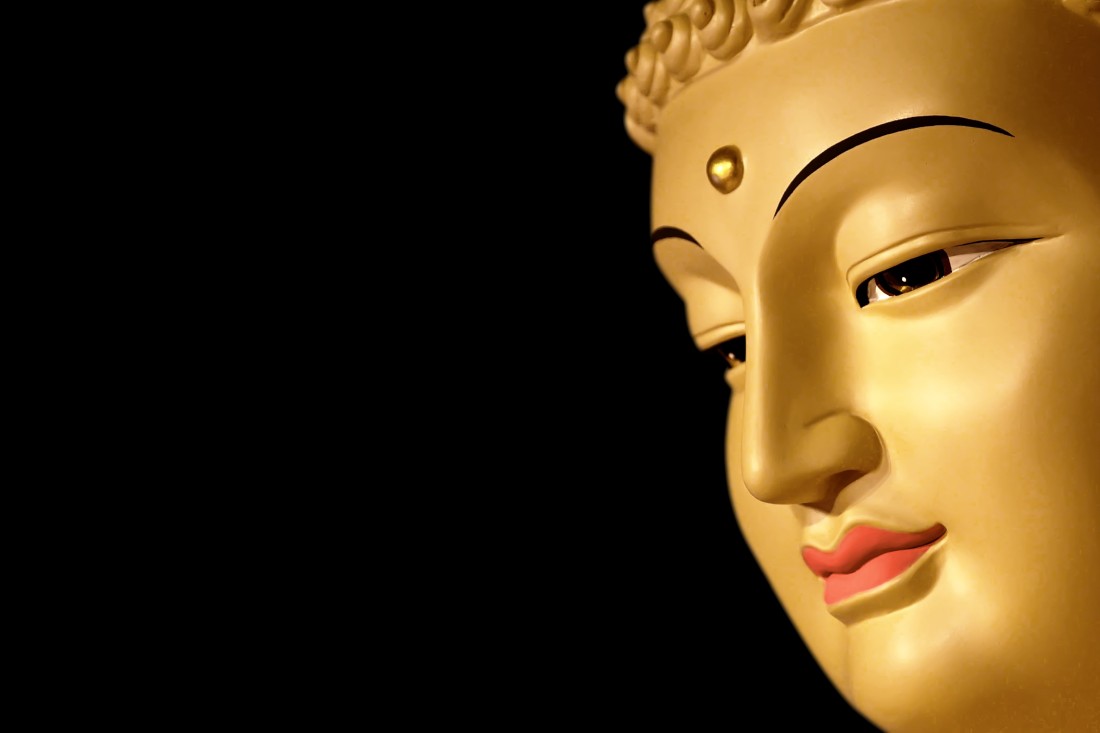
BUDDHA

Lord Buddha is considered to be an avatar of Vishnu by tradition within Hinduism. While some versions mention Gautam Buddha as being ...